Empower Your Organization with Scalable, Secure Infrastructure
Cloud technology allows companies to innovate faster, reduce costs and better serve customers. By developing applications natively in the cloud, organizations can rapidly deploy new features, dynamically scale infrastructure as needed, and future-proof their technology stacks.
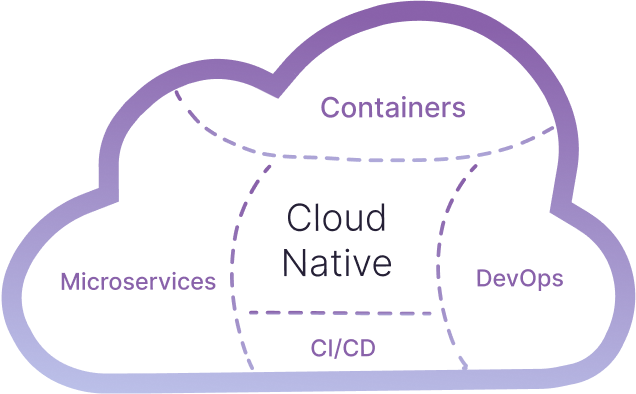
We decompose applications into standalone services packaged in containers for scalability, isolation and continuous delivery.
Serverless Architecture Design
We build apps that maximize cost efficiency by automatically scaling event-driven functions without server management.
Cloud Security Implementation
Our team sets up identity management, encryption, firewalls and monitoring to protect workloads and data across cloud platforms.
Multi-Cloud Management
We ensure consistent operations, cost optimization and disaster recovery across multiple cloud providers through standardization and automation.
Application Migration
Embracing Cloud-Native Development and Operations
As application portfolios grow in size and complexity, maintaining costly on-premises infrastructure can strain IT budgets and slow innovation. Meanwhile, public cloud platforms now deliver virtually unlimited scalability and high availability at lower costs. Migration provides a path for organizations to streamline operations and empower developments.
Building Software the Cloud-Native Way
As organizations embrace cloud-first strategies, developing applications native to public clouds delivers clear advantages over merely migrating existing software. Cloud-native apps are purpose-built for modern infrastructure like compute services, storage and databases. They leverage elasticity, high availability zones, auto-scaling and other cloud services by design.
Designing Scalable and Robust Cloud Solutions
As more workloads transition to the cloud, a well-architected infrastructure becomes essential to fully unlocking the benefits of elasticity, availability and agility. Cloud architecture refers to frameworks and best practices for deploying distributed systems across on-premises datacenters and public clouds in a standardized, scalable and secure manner.
Breaking Down Silos for Faster Delivery
Traditional development and operations teams tended to work sequentially, with long handoffs between code completion and deployment. This resulted in slow, error-prone releases. DevOps aims to align development processes end-to-end from code to monitoring. It unites previously siloed teams through automation and shared tooling.
On-Prem and Cloud Synergies
While public clouds offer agility and scalability, some workloads require customization, security or low latency that private infrastructure provides. A hybrid cloud bridges these environments, enabling businesses to place applications based on their unique needs. It combines on-premises infrastructure, virtual private clouds and public cloud services behind a common management plane.
Managing Spending in Cloud Environments
Public cloud models bill customers for actual resource usage rather than fixed capacity reservations. While this usage-based pricing model provides flexibility, it can be difficult for organizations to track spending across different accounts and services. Left unchecked, cloud costs may spiral out of control.
Lorem ipsum dolor sit amet, consectetur adipiscing elit, sed do eiusmod tempor incididunt ut labore et dolore magna aliqua. Ut enim ad minim veniam, quis nostrud exercitation ullamco laboris Lorem ipsum dolor sit amet, consectetur adipiscing elit, sed do eiusmod tempor incididunt ut labore et dolore magna aliqua. Ut enim ad minim veniam, quis nostrud exercitation ullamco laborisLorem ipsum dolor sit amet, consectetur adipiscing elit, sed do eiusmod tempor incididunt ut labore et dolore magna aliqua. Ut enim ad minim veniam, quis nostrud exercitation ullamco laboris
Go to Use Case Title
Services Associated with Cloud Development
AWS Lambda
AWS Lambda allows you to run code without provisioning or managing servers. You can trigger Lambda functions manually or in response to events. T
Azure Functions
Similar to AWS Lambda, Azure Functions lets you write code in multiple languages and have it run in response to events without managing infrastructure. Functions can be used to build webhooks, timers, and data processing pipelines with auto-scaling capabilities.
Terraform
Terraform is an infrastructure as code tool used to define cloud resources in a configuration file and provision them safely and efficiently. It allows infrastructure changes to be reviewed, tested and approved before deployment.
Docker
Docker provides a way to package an application with its libraries and dependencies into standardized building blocks called containers. Containers allow applications to run identically across development, test and production environments while isolating them from each other for easier distribution and maintenance.